

Why Your (literal) Voice Matters
Learn to love and leverage the sound of your own voice.

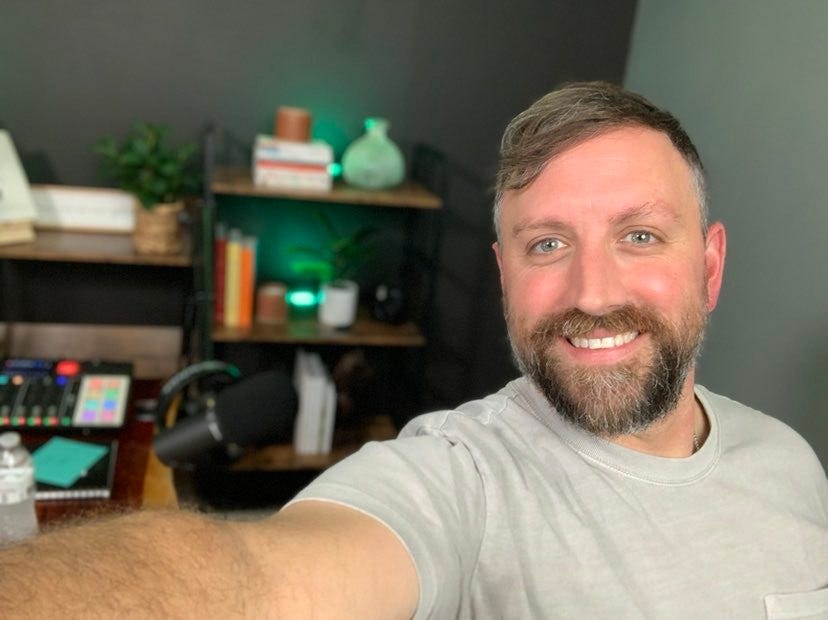
Who doesn’t hate the sound of their voice?
I haven’t met too many people who don’t grimace with disgust when they hear their voice played back. I have done the same thing. But, nearly ten years of podcasting, public speaking, interviews, and having my voice recorded on audio and video, have helped me grow accustomed to the sound of my voice. Let me be more clear: it’s not that I love the sound of my voice, it’s that I’ve grown to love the person behind the voice. His story, his growth, his progress, his heart, his intentions, his motivations.
I would bet that most podcasters, public speakers, talking heads, musicians, and anyone who gets behind a mic at some point have had to grapple with the sound of their voice. The way it feels hearing yourself speak. It can be awkward and uncomfortable, and awaken our inner critique. But at some point, they have to deal with the discomfort and dislike and choose to do it anyway. They choose vision and purpose over pain and discomfort. Their belief in themselves outweighs their discomfort with themselves.
Video may still be king, but audio is far from dead.
Video has been changing the way we enjoy and consume content since the invention of the film camera. And most recently, the internet, YouTube, social media, and smartphones are pushing consumers and producers more and more towards video content. I love video and film and think those mediums are some of the most powerful vehicles for storytelling.
However, video has its limitations just like any form of content. Video can cause the parts of our brain that imagine and daydream to go dormant. Whereas audio only awakens the imagination and stimulates our brains where we envision our own videos of what we are hearing. This phenomenon can be seen in people who read a book versus watching the movie version. By reading the book and hearing the story in their inner voice, they imagine a bigger and wider version of the story, scenes, and characters versus experiencing it on film where all the visuals are handed to you already imagined. Audio expands and awakens the imagination forcing us to think and daydream fully activated.
The continued growth of the podcasting and audiobook industries is proof that audio content is growing and still a desirable form of consuming stories and conversations.
Why does audio matter?
I think audio matters for a few simple reasons:
On-the-go content - it gives us content we can consume more on-the-go for our busy lives (i.e. commutes, exercising, travel, house chores, yard work, etc.).
Activates our imagination - it activates the side of our brain that imagines, daydreams, and envisions while we are listening.
Connects and Builds Trust - there is no question that hearing someone’s voice better connects us to that person and their story. We feel as if we know them on a different level when we hear them. When we feel connected, trust is built which fosters empathy, curiosity, compassion, and a stronger sense of connection to ourselves.
Frees up our focus and body - audio frees up our body a bit more than video to move, do other things, and helps us focus on our surroundings a bit more. Video can require our full attention making it hard to focus on anything else - including people in the room. I am all for engaging with my environment and the present moment more; audio enables this a lot better than video.
It feels more personal and intimate - hearing someone’s voice in your ears and head just feels more personal. It gives us the intimate feeling that we are having a conversation with the speaker. Like we are talking in the same room. Audio does that differently than video can.
Substack Gets It - Audio just hits different.
I have heard about Substack for a few years now and finally joined in April of 2024. I became obsessed quickly when I saw the quality of its content, the skill of its writers, and the humble accessibility of its creators. After only a few weeks of consuming, following, and writing posts, I began to discover writers who were offering audio narration of their posts. I was shocked and pleasantly surprised to see Substack offering and promoting this feature. Clearly they see the value audio has for consuming content. And with engagement already high with comments, likes, and reshared notes, I think audio will create even better engagement and connection.
How audio can help connect readers even deeper with writers (speaking from experience):
Audio lets readers hear the writer’s voice, literally. Can you imagine anyone other than Matthew McConaughey narrating his “Greenlights” book? Yuk. No matter how unique or “bad” someone’s voice may be, it’s their voice. Their voice is best for their story.
Simply put, readers will be able to consume more of a writer’s content on-the-go. I will be the first one to say how much I prefer reading over listening: it slows me down and I enjoy reading. But in our fast-paced culture, it would be nice to have the option to consume content from our favorite writers in a way that aligns with our busy schedules.
Readers will connect more deeply with writers, increasing trust, interest, curiosity, and engagement with their content. When readers become listeners, they connect on a deeper level. Readers feel closer to the writer when they can hear their story in their voice. It feels more personal, intimate, and special. It almost feels like the writer is talking directly and only to me.
Narration better communicates emotion, expression, inflection, and tone of voice. Imagine only communicating with your spouse, kids, or close friends and family through letters and emails. You would lose so much emotion, heart, and spirit. A story and conversation come alive when you hear it. The emotions leap off the page when you hear someone read a story or an emotional point, especially when it’s the voice of the author.
Your (literal) voice matters. It starts with loving yourself.
No really, it does. Your voice matters, literally. No matter how annoyed you are by the sound of your voice, it matters. Readers and listeners are waiting for you to show up and be you. You are the only you we have. Help us get to know you and hear the voice behind the words. Thoughts create words, words tell stories, and stories were meant to be told and listened to.
To love your voice, you have to first choose to love yourself: warts, wounds, wins and all. Your voice is part of who you are. Speaking your stories and thoughts out loud can be healing and life-giving not just for your readers, but for you. Storytelling out loud can heal the storyteller the same or even more than the listeners. I have seen it happen and experienced it first-hand. Love yourself better and I can promise you will learn to love your voice more.
Simple steps to add your voice to your Substack if you’re a writer:
Pick a favorite, brief post you have already written (or record for an upcoming new one).
Edit that post and record a narration for it (read along from Substack on your phone while you record to your pc).
Save that new updated version.
Share that post with a new note mentioning you are experimenting with narration. See what your readers think and ask for feedback.
Wash, rinse, repeat. Be open to honest feedback and constructive criticism.
Take notice of any difference in engagement (likes, comments, reshares, DMs).
Let me be your case study.
I am practicing what I preach with all of this. From podcasts and Instagram stories to Substack narrations.
Stary by reading one of my posts here on Substack.
Then listen to me reading it. I have narration for every one of my posts.
Then, consider these questions:
Did you feel different about the content?
Did you feel a deeper connection to me?
Did the story/content relate differently?
Did you feel differently about yourself while listening?
What were you busy doing while listening? Where were you?
What was happening in your mind - did you imagine, wonder, envision, visualize?
Did it make you want to engage with me or my content more, less, or the same?
Jonathan, I love this article, first because I hate doing video. I just feel awkward trying to stare at a camera and imagine it is a person. BUT I don't like my voice. Although for many years I made my living over the phone counseling, and working with people and was told I had a great voice, I don't like hearing myself.
But you make a good point here for the value of audio (over video) which I agree with, and find to be true even in my own life. Thank you!